Evaluate AKA Versus American Top Team Training Camps
The moment Islam Makhachev locked that arm-triangle against Charles Oliveira at UFC 280, the broadcast barely had time to process what it had witnessed — a near-flawless execution of positional…
When the Collision Course Split: Two Philosophies Under One Octagon Roof
The moment Islam Makhachev locked that arm-triangle against Charles Oliveira at UFC 280, the broadcast barely had time to process what it had witnessed — a near-flawless execution of positional control born not from brute athleticism but from a deeply rehearsed chain of transitions. Every grip, every hip adjustment, every breath Makhachev took had the unmistakable fingerprint of American Kickboxing Academy. Meanwhile, across the cage, Oliveira's camp at Chute Boxe had prepared him brilliantly for stand-up exchanges, yet the grappling chess match exposed a gap that only elite wrestling-heavy environments can fill. It was a moment that crystallized something practitioners in MMA have debated for years: the way a training camp shapes an athlete isn't just about who holds pads. It's about the entire biomechanical and psychological ecosystem surrounding a fighter every single day.
For anyone evaluating where a professional mixed martial artist should invest their formative — or career-defining — years, the conversation almost invariably narrows to two institutions that have produced an extraordinary share of UFC champions: American Kickboxing Academy in San Jose, California, and American Top Team in Coconut Creek, Florida. Both are legendary. Both have legitimate claims to being the best MMA gym on the planet. But they are profoundly different in philosophy, structure, and the kind of fighter they tend to build. Choosing between them, or understanding what each offers at the highest level, requires looking past the trophy cases and into the daily mechanics of how champions are actually made.
The Foundational Philosophy: Control Versus Versatility
AKA's DNA traces back to Javier Mendez, a kickboxing champion turned head coach who built the gym around a deceptively simple premise: if you can control where the fight takes place, you control the outcome. This manifests in what fighters who've trained there consistently describe as an almost obsessive emphasis on wrestling — not collegiate folkstyle in isolation, but wrestling as the connective tissue between every phase of combat. The kinetic chain, in AKA's world, begins at the feet and flows through hip pressure, head position, and grip dominance into takedowns that feel less like athletic explosions and more like inevitabilities.
Khabib Nurmagovedov's entire career arc is the living proof of this philosophy. His ability to chain single-leg attempts into body-lock trips into cage-pressured mat returns wasn't just talent — it was the product of thousands of repetitions inside AKA's walls, where coaches drill the principle that no exchange is ever truly neutral. Every scramble is an opportunity to advance position. Every defensive posture is a potential offensive launch point.
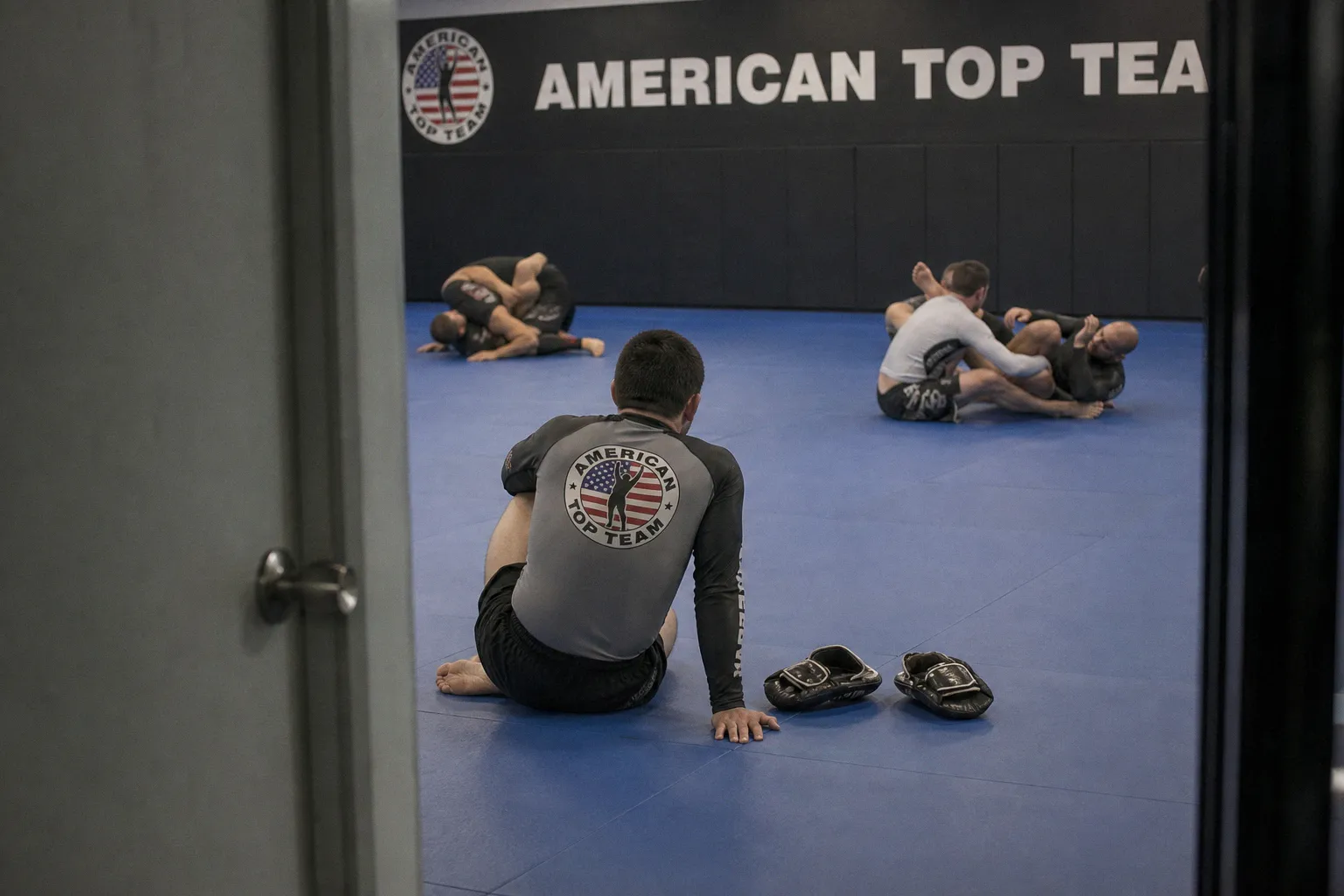
American Top Team, co-founded by Dan Lambert and historically steered by striking coaches like Marcus "Conan" Silveira and grappling specialists like Mike Brown, takes a fundamentally different approach. ATT doesn't privilege one phase of combat over another. Instead, it cultivates a deep roster of specialists in every discipline — boxing, Muay Thai, Brazilian jiu-jitsu, wrestling — and trusts that the fighter, with coaching guidance, will assemble a personal composite. The philosophy is less about imposing a singular combat identity and more about providing the widest possible toolbox.
The result, at ATT, is visible in the sheer diversity of fighting styles that have emerged from Coconut Creek. Dustin Poirier's boxing-forward pressure game, Jorge Masvidal's counter-striking lethality, Amanda Nunes's devastating knockout power — these fighters don't share a template. They share a facility, a support system, and the freedom to become whoever they need to be in the cage.
AKA builds architects of control; ATT cultivates artists of adaptation. Neither philosophy is wrong — but they produce fundamentally different fighters.
The Daily Grind: How Training Actually Looks
Walk into AKA on a Tuesday morning, and you'll notice something distinctive immediately: the sparring is heavy, the wrestling rooms are packed, and the atmosphere carries a quiet intensity that borders on confrontation. There's an unspoken expectation that everyone on the mat is preparing for the most important fight of their life, whether they have a bout booked or not. Javier Mendez has spoken openly about the culture of accountability — if you're not matching the intensity of the room, you'll be made aware of it, not through words, but through the physical reality of training partners who refuse to coast.
This environment has a specific biomechanical effect on fighters. The constant wrestling pressure forces athletes to develop what sports scientists call "positional awareness" — an internalized map of where their hips, shoulders, and head are relative to the opponent at every micro-second. Fighters who survive AKA's training load tend to develop extraordinary base stability and scramble recovery. Their stance adjustments under pressure become reflexive rather than conscious. You can see it in how Daniel Cormier, even at heavyweight, maintained his wrestling entries against significantly larger opponents — his hip positioning was so ingrained that it functioned almost as autonomic movement.
ATT's daily structure, by contrast, is more modular. Fighters typically work with dedicated coaches for each discipline across separate sessions — a striking class in the morning, grappling in the afternoon, with strength and conditioning woven throughout. The sparring tends to be more technical and controlled, with an emphasis on scenario-based work: "You're down two rounds, you need a finish in the third — now work from this position." This approach produces fighters who are comfortable problem-solving under stress, who can shift gears mid-fight when Plan A isn't working.
The practical difference matters enormously. AKA fighters often enter the cage with a clear, rehearsed sequence of attacks built around their wrestling advantage. ATT fighters are more likely to adjust on the fly, reading the opponent's patterns in real time and pivoting. Neither is inherently superior, but each carries distinct risk profiles. AKA's approach can become predictable if the wrestling entry is consistently stuffed; ATT's approach can lead to hesitation if a fighter has too many options and insufficient clarity on which to prioritize.
Championship Pedigree: What the Record Actually Shows
The numbers tell a compelling story, though not a simple one. AKA has produced multiple UFC champions across weight classes — Khabib Nurmagovedov, Daniel Cormier, Cain Velasquez, Luke Rockhold, and Islam Makhachev among them. The through-line connecting these fighters is strikingly consistent: elite wrestling, suffocating top control, and an almost supernatural ability to maintain pace in later rounds. Their champions tend to dominate through positional superiority rather than highlight-reel finishes, though finishes certainly come — they simply arrive as the logical conclusion of accumulated control rather than sudden violence.
ATT's champion lineage is arguably even deeper in terms of sheer volume and diversity. Amanda Nunes, Tyron Woodley, Robbie Lawler, Joanna Jędrzejczyk, Dustin Poirier (who spent significant time training there), Jorge Masvidal, and Petr Yan have all called ATT home during peak career phases. The breadth of fighting styles represented — from Nunes's terrifying power to Jędrzejczyk's volume striking to Lawler's berserker pressure — speaks to the gym's ability to foster individuality within a collective framework.
What's particularly instructive is how champions from each gym tend to lose. AKA champions, when they fall, often do so against opponents who can neutralize their wrestling with elite takedown defense or submissions from bottom position — think Rockhold against Michael Bisping, where the reliance on top control became a vulnerability when Bisping's counter-left landed before the grappling sequence could begin. ATT champions, when they fall, sometimes do so against more disciplined, single-gameplan opponents who can deny them the mid-fight adjustments they rely on — Woodley's losses to Kamaru Usman and Colby Covington being textbook examples of opponents who refused to engage in the kind of reactive exchanges ATT fighters thrive in.
| Dimension | AKA (San Jose) | ATT (Coconut Creek) |
|---|---|---|
| Core philosophy | Wrestling as the central axis of all combat phases | Multi-discipline depth; fighter chooses composite style |
| Sparring culture | Heavy, high-intensity, accountability-driven | Technical, scenario-based, controlled |
| Champion archetype | Positional dominators with exceptional pace | Versatile adapters with diverse finishing ability |
| Key risk | Predictability if wrestling is neutralized | Decision-making hesitation from option overload |
| Typical late-fight approach | Continue grinding control; outwork opponent | Shift to highest-percentage finish mode |
| Standout biomechanical output | Hip-dominant entries, base stability, scramble recovery | Combination fluency, angle creation, defensive footwork |
The Coaching Ecosystem: Depth Behind the Headline Names
One of the most overlooked factors in evaluating any elite training camp is what exists beneath the head coach's name on the wall. Javier Mendez at AKA is, without question, one of the most accomplished MMA coaches alive. But the strength of AKA's system also depends on coaches like Leandro Vieira for jiu-jitsu refinement and the wrestling-specific instruction that has historically drawn from training partners who are themselves high-level competitors. The camp's ability to recruit and retain elite sparring partners — Islam Makhachev training alongside Khabib during his active years, for example — creates a self-reinforcing cycle where the training room's ceiling continuously rises.
ATT's coaching depth is arguably its single greatest structural advantage. Dan Lambert has assembled a staff that includes world-class practitioners in virtually every relevant discipline. The boxing instruction is legitimate boxing coaching, not MMA-boxing hybrid shortcuts. The Brazilian jiu-jitsu program, with coaches like Marcos "Parrumpa" da Matta, operates at a level that produces gi and no-gi competitors alongside MMA fighters. The wrestling program, while perhaps not carrying the same mythological status as AKA's, brings in specialists who understand the specific adaptations needed for cage wrestling rather than purely Olympic or collegiate formats.
For a fighter evaluating where to train, this depth matters because of a biomechanical principle that's easy to underestimate: specificity of instruction. A striking coach who understands the precise pronation adjustments needed when throwing an elbow from the Thai clinch against a taller opponent provides a qualitatively different learning experience than a generalist who tells you to "work your Muay Thai." ATT's breadth of specialist coaches means fighters receive that level of specificity across more phases of combat.
The Mental Architecture: How Each Camp Builds Psychological Resilience
This is where Elena Vance's lens — the psychological interior of elite athletes — reveals perhaps the starkest difference between the two camps. AKA builds mental toughness through an almost monastic discipline. The expectation is simple: show up, work harder than everyone else, and accept that discomfort is not a bug but a feature of the process. Fighters who emerge from AKA's system tend to possess a particular brand of calm under fire — the kind that comes not from meditation apps or sports psychology sessions but from having been physically overwhelmed in training so many times that competition feels, by comparison, manageable.
Khabib's composure in the second Conor McGregor fight, when he was absorbing shots in the opening round before systematically dismantling McGregor's defensive posture, wasn't zen-like tranquility. It was the practiced equilibrium of someone who had been in that exact sensory environment — absorbing damage, managing distance, waiting for the wrestling opening — hundreds of times before the fight ever happened. The emotional regulation was biomechanical: his nervous system had been calibrated through repetition to interpret incoming strikes as data points rather than threats.
ATT takes a more explicitly psychological approach. The camp has historically employed sports psychologists and mental performance coaches who work with fighters on visualization, pre-fight routine optimization, and emotional state management. Jorge Masvidal's transformation from a talented but inconsistent journeyman to a knockout artist capable of finishing Ben Askren in five seconds didn't happen solely because his hands got faster. It happened because his belief system was restructured — he entered the cage that night with a psychological architecture that allowed him to commit to a flying knee with complete conviction, no second-guessing, no hesitation.
The fighter who survives AKA's training room doesn't need a sports psychologist to tell them they belong. The fighter who thrives at ATT doesn't need a single guru to define their identity — they've built it themselves, brick by discipline-specific brick.
Weight Cutting, Recovery, and the Physical Infrastructure
Any practical evaluation of these camps must address the unglamorous reality of weight management and physical recovery — two areas where the difference between a good gym and a great one can mean the difference between a championship reign and a career derailed by health complications.
AKA's approach to weight cutting has historically leaned traditional: fighters manage their nutrition with the help of nutritionists brought in on a consulting basis, and the camp's culture accepts a certain degree of suffering as part of the professional obligation. This has drawn criticism, particularly as the science around hydration and performance has evolved. The UFC's own performance institute has published data suggesting that fighters who cut more than 8-10% of their body weight in the week before a fight show measurably reduced reaction times and cognitive function — a finding that has forced many camps to reconsider their approach.
ATT has moved more aggressively toward modern weight management protocols. The facility's proximity to South Florida's sports science infrastructure means fighters have access to body composition analysis, DEXA scanning, and nutritionists who work with longitudinal data rather than short-notice crash cuts. Amanda Nunes's ability to make bantamweight while maintaining her devastating power was, by many accounts, a function of sophisticated nutritional periodization that began months before fight week rather than days.
Recovery infrastructure at both camps is world-class, but again with different emphases. AKA fighters tend to rely on traditional recovery modalities — ice baths, massage, active rest — supplemented by the natural advantage of training at elevation-adjacent locations in Northern California. ATT has invested heavily in hyperbaric chambers, cryotherapy, and the kind of technology-forward recovery suites that you'd expect from a facility bankrolled in part by Dan Lambert's considerable business resources.
For the Fighter Standing at the Crossroads: A Practical Framework
If you're an aspiring professional — or an established fighter considering a change of scenery — the decision between AKA and ATT isn't about which gym is "better." It's about alignment with who you are and who you need to become.
Consider AKA if your natural game is built around pressure, clinch work, and positional control. If you have a wrestling base or are willing to commit to making wrestling the foundation of your style. If you respond well to high-intensity, accountability-driven environments where the expectation is that everyone pushes everyone else to their physical limits. If you're a fighter who thrives on simplicity — who wants a clear, rehearsed sequence of attacks rather than a menu of options.
Consider ATT if your game is built around striking versatility or if you want to develop multiple paths to victory. If you're the kind of athlete who reads patterns in real time and wants coaches who will give you tools for every scenario rather than a singular gameplan. If you value the freedom to build a personal fighting identity within a world-class support system. If you're disciplined enough to manage modular training without the external structure of a more monolithic environment driving your daily intensity.
Both camps will push you harder than you thought possible. Both have produced undeniable champions. Both have also produced fighters who plateaued, who burned out, who found that the system that elevated others didn't fit their particular architecture. The honest answer — the one that doesn't make for a clean headline — is that the "best" camp is the one whose daily reality matches your psychological wiring, your biomechanical strengths, and your willingness to sacrifice what needs sacrificing to reach the level you're chasing.
The Verdict
Having observed both environments from close range — watching the way AKA's mat room hums with a particular frequency of controlled aggression, and the way ATT's Coconut Creek facility operates with the organized intensity of a professional sports franchise — my assessment is this: AKA remains the single most effective environment for building a wrestling-dominant champion in 2024 and beyond. Islam Makhachev's continued reign is evidence that Javier Mendez's system is not just surviving the evolution of MMA but actively defining its next chapter. If your ceiling as a fighter depends on being the best grappler in your division, San Jose is where you go.
But for the fighter who doesn't fit neatly into a wrestling-first template — the striker who needs grappling competence without sacrificing their primary weapon, the athlete who needs a sports psychologist as much as a sparring partner, the veteran who needs sophisticated recovery and nutrition infrastructure to extend a career past its natural peak — ATT offers a more comprehensive and individually adaptable ecosystem. The sheer diversity of champions it has produced, across genders, weight classes, and fighting styles, is not an accident. It's the direct output of a system designed to serve many archetypes rather than one.
Neither camp is a guarantee. Champions have emerged from backyards in Dagestan and basements in Brazil. But for the professional fighter making a calculated investment of their finite prime years, understanding the specific biomechanical, psychological, and structural realities of these two institutions isn't just useful — it's essential. The octagon doesn't care about your potential. It cares about what you've rehearsed, and where you rehearsed it.