Optimize string tension for clay versus hard court surfaces
Professional players carry six to eight rackets into a match, and on average, two or three of those frames leave the bag re-strung before the tournament ends. The reason is rarely equipment failure. It is calibration.
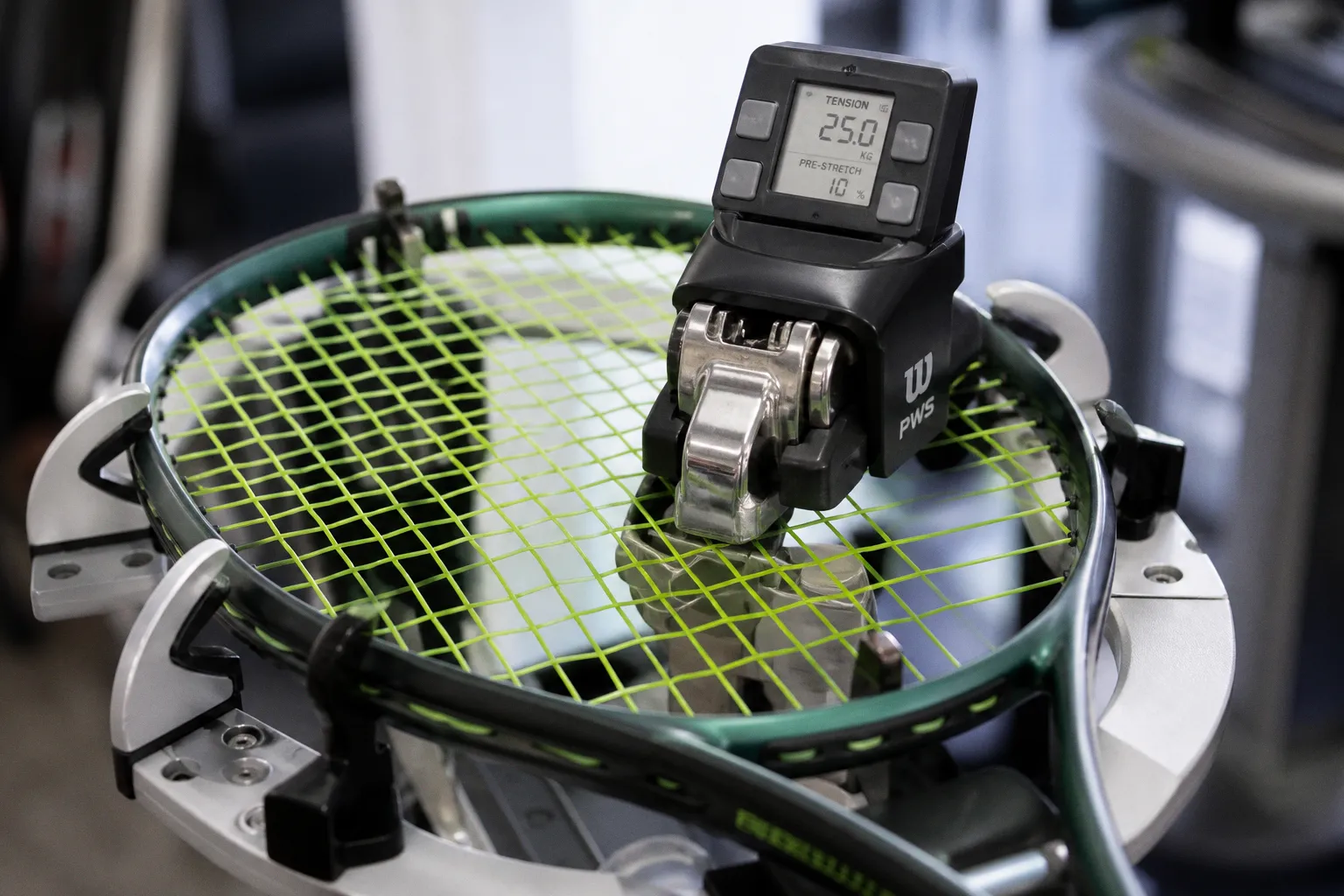
This is a breakdown of the mechanics behind that adjustment. The objective is not to locate a "perfect" tension — no such number exists at the individual level. The objective is to understand the trade-off between power and control, decode how surface speed shifts that trade-off, and build a personal tension range that responds to clay, hard courts, heat, and humidity. The data is drawn from professional stringing protocols, surface friction studies, and tour-level practice.
The Physics of Surface Interaction: Trampoline Effect vs. Control
Every tennis court sits somewhere on a friction-and-bounce spectrum, and that spectrum dictates how the ball interacts with both the surface and the string bed. Clay is the slowest common surface. The loose granular top layer creates higher friction with the ball, slowing its forward momentum after the bounce and producing a higher, more vertical trajectory. Hard courts — acrylic over asphalt or concrete — generate a faster, lower, and more uniform bounce with less friction and more skid. Grass sits at the opposite extreme from clay: low friction, fast pace, low bounce, but most players never train on it long enough to build a dedicated tension setup.
The string bed has its own physics, and the central metric is deflection. When the ball strikes the strings, the bed deflects downward, stores kinetic energy, and snaps back, transferring additional velocity to the ball. This is the trampoline effect. Lower string tension increases deflection and dwell time — the duration the ball sits on the strings. That longer contact window allows an aggressive low-to-high swing path to impart more rotational velocity, producing higher spin rates. Higher tension decreases deflection, shortens dwell time, and produces a flatter, more directional ball flight with reduced spin potential but tighter placement.
The interaction between string pattern and tension amplifies the physics further. An open 16×19 pattern at low tension deflects more freely than a dense 18×20 at the same number, because the longer individual mains and crosses have more room to stretch and recover. This is why two players at identical tension on the same string can experience entirely different ball response — the pattern multiplies or dampens the effect of every pound on the machine.
The trampoline effect is not a feature to add or remove. It is a dial with two directions: lower tension tilts toward spin and depth, higher tension tilts toward placement and predictability.
The trade-off is absolute. Every pound of tension added to one side of the equation is subtracted from the other. Players who chase power at low tensions must compensate with technique and string pattern. Players who chase precision at high tensions sacrifice the free energy the string bed would otherwise provide. The stringer's job is to position that dial for the surface in play.
Tailoring Tension for Clay: Maximizing Spin and Dwell Time
On clay, the slower court speed already neutralizes some of the pace the ball carries through the strike zone. The counter-weapon is topspin, and the lever for generating it is string deflection. This is why most tour-level clay specialists string 1 to 3 pounds looser than their hard-court baseline. A setup strung at 56 pounds for a hard-court tournament typically drops to 53 or 54 pounds for the European clay swing, and some heavy topspin players drop further still — into the high 40s with co-polyester constructions that retain control at lower absolute numbers.
The mechanism is direct. At lower tension, the strings sit deeper in their deflection arc at the moment of contact. The ball compresses against the string bed for an extra 2 to 4 milliseconds, and during that extended window, a brushing swing path can impart 15 to 25 percent more rotational velocity on the ball. The result is a steeper descent into the opponent's strike zone and a higher kick on the bounce — precisely the geometry that wins extended rallies on slower surfaces. Every additional 500 rpm of topspin adds roughly 4 to 6 inches of net clearance at typical tour swing speeds, and the lower-tension string bed is the most reliable lever a player has to manufacture those rpms without overcooking the stroke.
The depth equation also favors lower tension on clay. Because the granular surface absorbs more horizontal energy on the bounce, a ball struck with moderate pace needs to arrive deeper in the court to remain effective. The trampoline effect at reduced tension provides that free depth without requiring the player to swing harder, which preserves margins and reduces fatigue over five-set matches that routinely exceed three hours on the surface.
Players who struggle on clay despite hitting heavy from the baseline often share one overlooked variable: their string bed is fighting them. The swing path may be correct, but the strings are too tight to deflect deep enough to grip the ball through the brushing motion. The fix is rarely technique. It is 2 pounds of tension.
On clay, the strings need to work with the surface, not against it. Lower tension lets the string bed breathe, extending contact and multiplying the topspin a heavy swing already produces.
Tightening Up for Hard Courts: Precision and Accuracy Management
Hard courts invert the equation. The acrylic surface produces a faster, more skidding bounce with less vertical climb, meaning a flatter ball stays effective longer. At the same time, the lower friction allows the ball to travel further horizontally after the bounce, opening up the geometry of the court but also widening the lines. A ball struck with even slightly excessive pace will sail long before a clay court would have pulled it back.
This is why hard-court setups trend higher in tension — typically 2 to 5 pounds above the player's clay baseline, often landing in the 55 to 60 pound range for elite players using co-polyester strings. The tighter string bed reduces deflection, limiting the trampoline effect and the inadvertent depth the ball can pick up off the strings. The output is more predictable ball flight and tighter dispersion patterns, even on a faster surface where the margin for error is structurally narrower.
The trade-off is mechanical. A tighter string bed transfers more of the energy generation responsibility from the racket to the player. Hard-court tennis at the elite level therefore rewards clean strikers and punishing flat-hitters — players who can manufacture their own pace rather than borrow it from the strings. The setup is unforgiving, but it rewards those who can execute. Heavy topspin remains viable on hard courts, but it is generated through swing speed and racket-head acceleration rather than dwell time, and the tension dial sits accordingly higher.
The faster surface also changes the serving equation. A tighter string bed on a hard court produces a flatter, more precise ball on serve — critical for targeting lines and corners at speeds above 120 mph. The reduced deflection limits the "launch" effect that lower tension can introduce on a flat serve, keeping the ball trajectory tighter to the net tape and more consistent across repeated efforts. For players whose service games depend on placement over raw velocity, the hard-court tension bump is not optional — it is structural.
| Parameter | Clay Court | Hard Court |
|---|---|---|
| Typical tension adjustment | −1 to −3 lbs vs. baseline | +2 to +5 lbs vs. baseline |
| Surface speed | Slow (high friction) | Medium-fast (low friction) |
| Bounce profile | Higher, slower, more vertical | Lower, faster, more horizontal |
| Optimal string deflection | Higher (more dwell time) | Lower (reduced deflection) |
| Spin emphasis | Heavy topspin | Mixed: flat or moderate spin |
| Primary risk factor | Insufficient pace and depth | Loss of directional control |
| Trampoline effect priority | Maximize | Minimize |
| Common string gauge emphasis | Thinner (17/18) for spin and feel | Mid (16/17) for durability and control |
Environmental Variables: Compensating for Heat and Humidity
Surface is not the only variable the stringer tracks. Atmospheric conditions affect string elasticity in measurable ways, and tour-level stringers adjust for them systematically. Polyester strings — the dominant choice on the modern tour — soften as temperature rises. In hotter conditions, the same string bed will deflect further and feel livelier at impact, behaving as if it had been strung 1 to 2 pounds lower than the number on the machine. The molecular structure of the polymer loosens slightly with thermal expansion, and the response curve is consistent enough to calibrate against.
The standard adjustment is to add 1 to 2 pounds of tension on a hot day or in humid conditions to compensate for the softening. In cooler indoor environments, the inverse applies — drop tension by approximately 1 pound to restore the deflection profile the player has calibrated for. The change is small in absolute terms but consistent across playing sessions, and ignoring it produces setup drift between rounds played in different conditions.
Humidity affects string response through a separate mechanism. Strings absorb trace moisture, which can change the coefficient of friction between mains and crosses and subtly alter the snap-back behavior that contributes to spin generation. The effect is minor — usually less than the equivalent of 1 pound of tension — but it accumulates over multi-week swings and explains why stringers working with the same player through a clay season often re-tune by the second or third round of a given event. The surface itself is also responsive to humidity: clay courts play heavier and slower after rain, and hard courts can develop a thin moisture film that changes the initial bounce. The string adjustment therefore compounds with the surface adjustment, not in isolation.
Ball type interacts with the environmental picture as well. Pressurized balls play faster in heat — the internal pressure rises roughly 1 psi for every 10°F increase — and slower in cold conditions. This means the effective pace arriving at the string bed shifts with temperature even before the string itself changes. A stringer calibrating for a 95°F afternoon in Miami is compensating for both the softer string and the livelier ball, which is why the combined adjustment can reach 2 to 3 pounds from the player's neutral baseline.
For outdoor tournaments in transitional weather — Roland Garros across late spring, the US Open through late-summer heat, the Australian Open in mid-summer conditions — this becomes a daily conversation between player and stringer. The frame is unchanged. The string gauge and composition are unchanged. But the tension number on the machine can move 2 pounds from one round to the next, and a player who fails to track the variable often misreads the cause of late-set inconsistency.
String tension is not a single number. It is a moving target the player and stringer chase across surface, weather, and opponent.
Altitude deserves a footnote, though most tour stops sit near sea level. At higher elevations — events in Bogotá, Quito, or certain South American challenger circuits above 8,000 feet — the thinner air reduces aerodynamic drag on the ball, producing faster flight and longer carries. The string bed does not change with altitude, but the ball behaves as if the court were faster, which pushes the adjustment logic closer to the hard-court direction. Players traveling from sea-level clay to altitude clay often add 1 to 2 pounds for this reason alone.
Finding Your Personal Range: Beyond Professional Standards
The professional tension range of 45 to 60 pounds is a useful perimeter but a misleading target for most competitive and recreational players. The reason is structural. Elite players generate their own pace through elite technique — swing speeds above 70 mph at contact, precise timing, and consistent strike zones near the sweet spot. The string bed is the final amplifier, not the primary power source. Below the professional level, the string bed does more of the work, and the same tension produces a noticeably different feel.
A club player swinging at 50 mph at contact will benefit more from a lower tension — typically 50 to 55 pounds — than from a tight setup that the swing speed cannot fully exploit. The trade-off still applies: lower tension will produce depth and comfort, but it will also reduce directional control on off-center hits. Players with shorter, slower swings also tend to fatigue faster at high tensions because the arm absorbs more of the impact force rather than the string bed distributing it. Over a two-hour match, that arm load compounds into diminished shot quality in the third set — exactly when the match is decided.
String gauge compounds the decision. Thinner strings (17, 18 gauge) deflect more for a given tension and produce more spin and feel, but they break faster and respond more sharply to environmental variables. Thicker strings (15L, 16 gauge) hold tension longer and offer more durability, but they dampen the trampoline effect and reduce the spin potential that clay rewards. The interaction is not linear — a 2-pound tension change on a 17-gauge string behaves differently than the same change on a 16-gauge string, and players serious about calibration test both variables together rather than isolating tension alone.
Hybrid setups add another layer. Many players string polyester mains at a lower tension and natural gut or multifilament crosses at a higher tension, blending the spin and durability of the co-poly with the comfort and feel of the gut. On clay, the hybrid approach lets the mains deflect freely while the crosses hold the bed together; on hard courts, both tensions typically rise by 2 to 3 pounds to tighten the response for the faster surface. The hybrid is not a shortcut — it doubles the number of variables in play — but for players willing to iterate, it offers a finer control surface than a uniform string job.
The methodology that actually works is iteration:
1. Establish a baseline tension at the midpoint of your likely range for the surface you play most.
2. Log the tension, string type, gauge, weather, surface, and any post-session notes — elbow feel, depth, control, mishit frequency, perceived pace off the string bed.
3. Play three to five sessions on the same baseline before adjusting. String bed response stabilizes after a few hours of play, and early impressions can mislead.
4. If depth is failing, drop tension 1 to 2 pounds. If control is failing, raise tension 1 to 2 pounds. Change only one variable per cycle.
5. Repeat across at least two full cycles per surface before locking in a number. Premature commitment prevents the data from telling you what it would.
6. Re-test every six to eight weeks. String beds lose tension gradually — polyester drops 5 to 10 percent in the first 24 hours after stringing and continues to decay — and the player adapts without noticing the drift.
The range that emerges over a season is personal, and no published number will replicate it without this loop. Modern players increasingly log this data digitally — alongside serve speeds, court coverage, and other performance metrics — building longitudinal records that span multiple seasons and surfaces. The methodology of treating small numerical adjustments as performance levers has spread across every serious training environment, and the principle is identical wherever the calibration happens: monitor the variable, measure the result, adjust by the smallest meaningful increment, and repeat.
The verdict is straightforward. There is no universal number. There is a range, narrowed by surface, modulated by weather, and confirmed through repetition. Players who treat tension as a fixed setting lose the most ground; players who treat it as a calibrated dial — adjusted by 1 to 5 pounds based on clay, hard court, heat, and humidity — extract a measurable edge that compounds across every match of a long season. Start at the midpoint of your range, log everything, and let the data drive the next adjustment. The string bed is the final variable in the geometry of every shot. Tune it like one.