UFC Weight Classes in KG: Best Divisions to Target
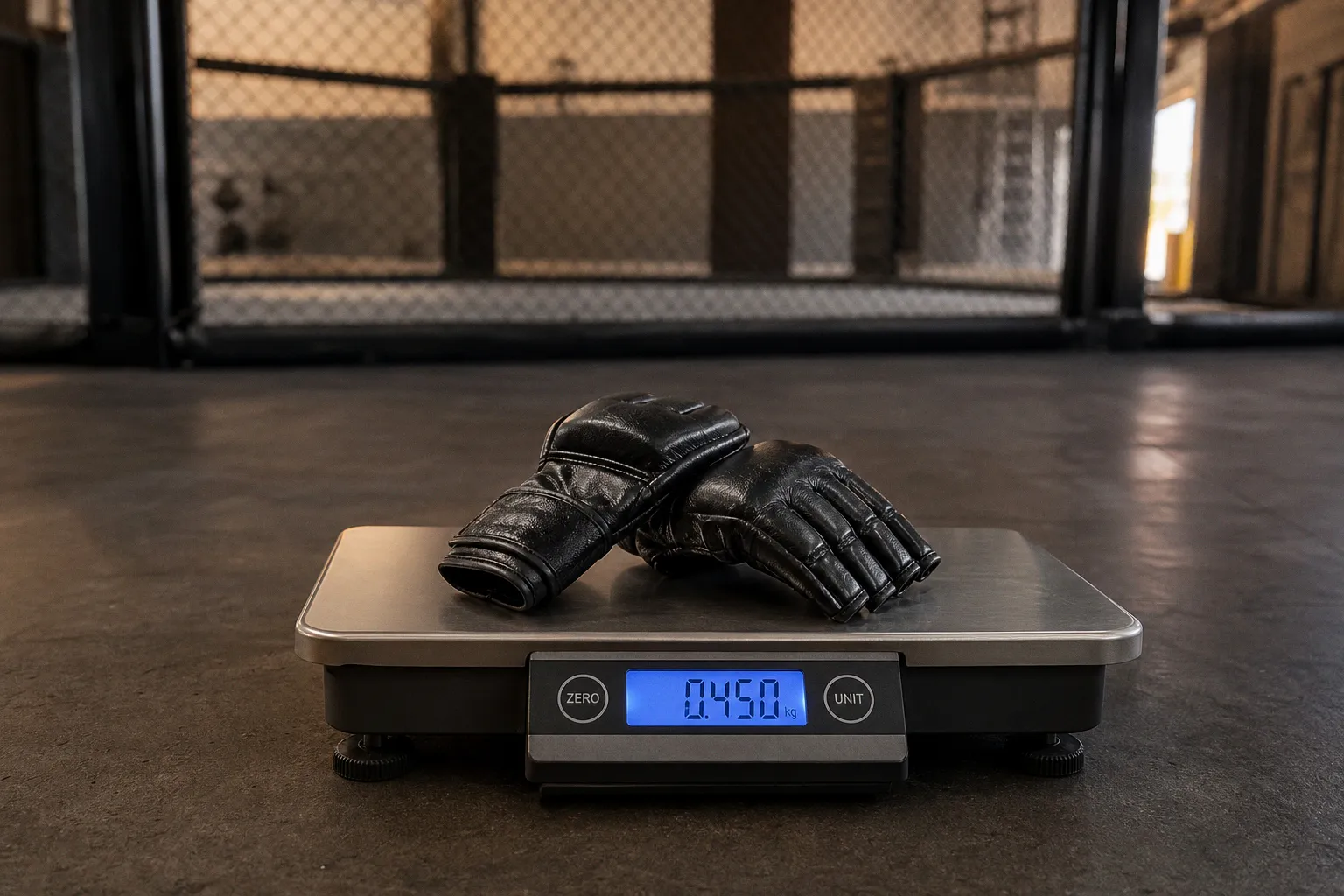
At UFC 274, Charles Oliveira stepped onto the scale 0.5 pounds above the lightweight championship limit. The margin was almost invisible; its consequences were not.
For athletes choosing a division, the question is not simply, “Where can I make the number?” It is where their frame, wrestling pace, striking mechanics, recovery capacity, and mental fortitude remain intact after making it. A fighter can arrive at a lower class with a visible size advantage, then discover that the dehydration has hollowed out the very reactions and composure that made them dangerous.
The UFC has 12 official divisions across its men’s and women’s rosters. The limits are standardized in pounds, but the metric figures tell a clearer story for most of the world: these are increments of a few kilograms, yet each one can require an entirely different relationship with food, water, sparring intensity, and identity.
The UFC divisions in kg chart: every official limit
The UFC’s modern weight structure is far removed from its early years. UFC 1 in 1993 had no weight classes at all; by 1997, divisions had arrived, and the Unified Rules of Mixed Martial Arts followed in 2000. What emerged is a hierarchy that asks fighters to fit highly specific physical profiles while still preserving enough athletic expression to compete.
Men’s UFC weight limits in kg
| Division | Official limit | Non-title bout maximum |
|---|---|---|
| Flyweight | 56.7 kg / 125 lb | 57.2 kg / 126 lb |
| Bantamweight | 61.2 kg / 135 lb | 61.7 kg / 136 lb |
| Featherweight | 65.8 kg / 145 lb | 66.2 kg / 146 lb |
| Lightweight | 70.3 kg / 155 lb | 70.8 kg / 156 lb |
| Welterweight | 77.1 kg / 170 lb | 77.6 kg / 171 lb |
| Middleweight | 83.9 kg / 185 lb | 84.4 kg / 186 lb |
| Light heavyweight | 93.0 kg / 205 lb | 93.4 kg / 206 lb |
| Heavyweight | 120.2 kg / 265 lb | 120.7 kg / 266 lb |
Women’s UFC weight limits in kg
| Division | Official limit | Non-title bout maximum |
|---|---|---|
| Strawweight | 52.2 kg / 115 lb | 52.6 kg / 116 lb |
| Flyweight | 56.7 kg / 125 lb | 57.2 kg / 126 lb |
| Bantamweight | 61.2 kg / 135 lb | 61.7 kg / 136 lb |
| Featherweight | 65.8 kg / 145 lb | 66.2 kg / 146 lb |
The table can mislead if read too casually. A seven-kilogram gap between men’s lightweight and welterweight, for instance, may look generous on paper. In practice, it contains several radically different archetypes: compact pressure wrestlers, long-limbed counterstrikers, durable clinch specialists, and athletes whose most decisive attribute is not size but their ability to recover from a cut without losing rhythm.
Women’s featherweight remains an official category at 65.8 kg, but it should not be treated as a regularly active, deeply populated route. A fighter evaluating the women’s divisions needs to look beyond the nominal limit and toward the realistic competitive opportunities in the weight class.
The right division is not the lowest number an athlete can reach. It is the highest level of performance they can carry through the scale and into the cage.
The one-pound allowance changes everything—until a title is involved
In non-title UFC bouts, an athlete is permitted to weigh one pound above the stated divisional limit. That is why a lightweight can officially weigh 156 pounds, or roughly 70.8 kg, for a standard fight. The allowance is small, but it has an outsized psychological effect during fight week.
A final half-kilogram can be the difference between a controlled, unpleasant cut and a panicked one. It may spare an athlete another hour of sweating, another bath, another attempt to wring fluid from a body that is already signaling distress. Camps plan around that pound. Nutritionists plan around it. So do fighters who have learned, often painfully, that the scale is not negotiable.
Championship bouts remove that softness entirely. A title challenger must be at or below the exact limit: 70.3 kg for lightweight, 77.1 kg for welterweight, 83.9 kg for middleweight, and so on. There is no extra pound. Missing by 0.5 pounds is still missing.
That distinction matters especially in divisions where a champion’s body composition has been built over years around a difficult cut. The title weight is not merely another weigh-in target; it is a stress test performed at the exact point where preparation becomes public. Oliveira’s UFC 274 miss remains a sharp example because it showed how little room exists between physical control and professional upheaval.
For a competitor, there are three questions worth asking long before a contract arrives:
1. Can the target weight be made without a late, improvised dehydration push? If the answer depends on a heroic final night, the division is probably too low.
2. Can the athlete rehydrate and move naturally the next day? Fast hands, defensive wrestling and calm decision-making are expensive when the nervous system is depleted.
3. Does the title limit change the calculation? A fighter who reliably makes a non-title maximum may still be vulnerable when the one-pound allowance disappears.
Weight cutting is not a cosmetic detail of MMA
The scale captures a number; it does not reveal the physiological cost paid to reach it. Research on UFC athletes has found that fighters lose nearly 7% of their total body weight within the 72 hours before the official weigh-in, then regain roughly 10% by competition time.
That sequence is often described with casual bravado: cut, rehydrate, fight. The body experiences it less elegantly. Rapid water loss can affect cardiovascular function, endurance, temperature regulation and cognitive sharpness. In a sport governed by fractions of a second—the sprawl that comes half a beat late, the guard pass recognized one exchange too slowly—that is not peripheral risk. It is the contest itself.
A fighter’s apparent size on fight night can therefore be a poor guide to where they truly belong. Some athletes restore fluid and glycogen with unusual efficiency; others look physically larger after rehydration but lose the elastic coordination that connects their kinetic chain. Their hips arrive a fraction behind the hands. Their entries become more linear. Their defense, usually built on instinctive micro-adjustments, grows stiff at precisely the wrong time.
The divisions and the likely trade-offs
| Division range | Potential attraction | The hidden pressure |
|---|---|---|
| 52.2–61.2 kg | Pace, speed, and technical volume can thrive | Small absolute changes in body mass may still be a major percentage of total weight |
| 65.8–70.3 kg | Deep talent pools and varied styles create meaningful career upside | Athletes are frequently tempted to chase size advantages through aggressive cuts |
| 77.1–83.9 kg | More room for naturally larger frames and strength-based grappling | The speed gap between a healthy athlete and a depleted cutter remains decisive |
| 93.0–120.2 kg | Less emphasis on fitting into narrowly compressed frames for many athletes | One clean mistake carries greater physical consequence; mobility and conditioning still separate contenders |
There is no universally “safe” UFC division. There are only individual tolerances, developed habits, and a camp’s willingness to distinguish manageable discomfort from avoidable damage. The fighter who can make a weight class once is not necessarily the fighter who can make it three times a year, through travel, media obligations, hard sparring, injuries and the emotional turbulence of fight week.
The best teams treat body weight as a year-round performance variable, not as a crisis to be solved on Thursday afternoon.
Why lightweight remains the benchmark—and the hardest target
Lightweight, capped at 70.3 kg, is widely regarded as the UFC’s most competitive and talent-rich division. It has become the sport’s central proving ground because the class gathers an unusually complete range of athletic qualities: quick enough for extended striking exchanges, strong enough for punishing clinch work, and deep enough in wrestling and jiu-jitsu that a specialist rarely survives on one dimension alone.
That density is what makes lightweight compelling. It is also what makes it unforgiving.
At 155 pounds, a prospect does not merely face experienced opponents. They face opponents whose physical preparation has been refined against elite resistance for years. A small weakness in cage wrestling becomes a reliable route to the mat. A defensive habit after throwing the right hand becomes visible to every sharp counterpuncher in the division. A poor rehydration response becomes a third-round problem, then a public diagnosis.
Lightweight is the best division to target only under a demanding set of conditions:
- The athlete’s natural build supports 70.3 kg without a chronic, extreme cut.
- Their game remains coherent after weight loss: footwork, wrestling reactions, hand speed and emotional control all survive the process.
- They possess enough technical breadth to avoid being sorted into a narrow matchup category.
- They accept that divisional depth means a slower, more exacting rise than in a thinner field.
For an athlete with a naturally lean frame who walks around close enough to the division to preserve training quality, lightweight can offer the most meaningful test of championship potential. For someone who must repeatedly sacrifice hydration, sleep, and late-camp sharpness to reach 70.3 kg, the romance of the division can become a trap.
Welterweight at 77.1 kg may produce a better version of that same fighter: less physically imposing on paper, perhaps, but more reactive, more resilient, and more capable of holding form when the bout becomes a long argument.
In a stacked division, freshness is a weapon. A fighter who arrives smaller but fully present can be far more dangerous than one who arrives large and already spent.
Choosing between adjacent divisions: the real comparison
The most consequential decisions usually happen between neighboring classes, not between the extremes of flyweight and heavyweight. A fighter hovering near a boundary is deciding whether to gain a reach-and-mass edge at the cost of energy, or accept larger opponents in exchange for a more stable body.
Lightweight at 70.3 kg versus welterweight at 77.1 kg
This is one of the sport’s most consequential dividing lines. Lightweight rewards fast transitions and layered offense, but its depth makes every technical flaw expensive. Welterweight provides more physical room, yet asks athletes to withstand larger clinch exchanges and stronger top pressure.
A fighter should lean toward lightweight when their athletic identity is based on speed, rapid level changes, sustained scrambling, and a cut that does not distort those gifts. Welterweight becomes more logical when the body begins to resist the 70.3 kg target, when recovery between sessions suffers, or when the athlete’s best work emerges with fuller glycogen stores and calmer decision-making.
Featherweight at 65.8 kg versus lightweight at 70.3 kg
The 4.5 kg difference looks modest. It rarely feels modest in camp. Featherweight can reward rangy technicians who can control distance without draining themselves, while lightweight may suit athletes whose strength in tie-ups and durability improve materially with less restriction.
The wrong move is to choose featherweight simply because the scale can be reached during an ideal camp. The better question is whether it can be reached after a disrupted camp, after travel, after a minor injury limits conditioning, and before a five-round opportunity where the exact limit applies.
Middleweight at 83.9 kg versus light heavyweight at 93.0 kg
Here, the trade-off often becomes more visible in wrestling and clinch mechanics. At middleweight, a naturally large athlete may exert forceful positional pressure but risk losing mobility during the cut. At light heavyweight, the same athlete may move more freely while encountering opponents whose mass alters every underhook battle and every defensive get-up.
The right choice rests less on scale vanity than on repeatability. A division is viable when the athlete can train intelligently inside it, not when they can starve their way into it once.
Missing weight is a financial wound and a credibility problem
A missed weight does not always cancel a fight. If the opponent agrees and the bout proceeds at a catchweight, the fighter who missed typically forfeits 20% of their purse to the other athlete. That is a direct financial penalty, but it is not the full cost.
The athlete has also introduced uncertainty into the contest. Was the cut poorly planned? Is there an injury? Will the fighter be adequately rehydrated? Can they maintain pace? Opponents and matchmakers notice patterns. In an environment where reliability is part of professional value, the scale becomes a measure of discipline as much as physiology.
Title bouts make the stakes even sharper. A champion who misses weight can be stripped; a challenger who misses cannot win the belt. The fight may remain, but its symbolic center has shifted. The athlete is no longer competing solely against an opponent. They are competing against the visible consequence of a preparation that did not hold.
That pressure can affect performance in subtler ways than fans acknowledge. A fighter who has spent the final hours of fight week chasing water loss may enter the cage carrying frustration, embarrassment, or the brittle need to prove that the number does not define them. Sometimes that urgency produces a spectacular showing. More often, it interferes with the patient reading of distance and tempo that elite MMA requires.
The best UFC weight class is the one that preserves the fighter
For pure competitive prestige, lightweight at 70.3 kg remains the benchmark. It is the UFC division where technical completeness is tested most relentlessly, and where success carries a particular credibility because the field is so dense. But it is not automatically the optimal destination for every athlete with the frame to touch 155 pounds.
The better target is the division where the fighter can make weight predictably, rehydrate intelligently, and retain the details that define their game: the live hips beneath a takedown defense, the relaxed shoulders before a counter, the patience to take a round without losing conviction. Those qualities do not appear on the official scale, yet they decide far more fights than the final decimal.
UFC weight classes in kg offer clean numerical boundaries. A fighter’s best division is never quite so clean. It is found in the space where physical capacity and competitive ambition stop fighting each other—and begin moving in the same direction.