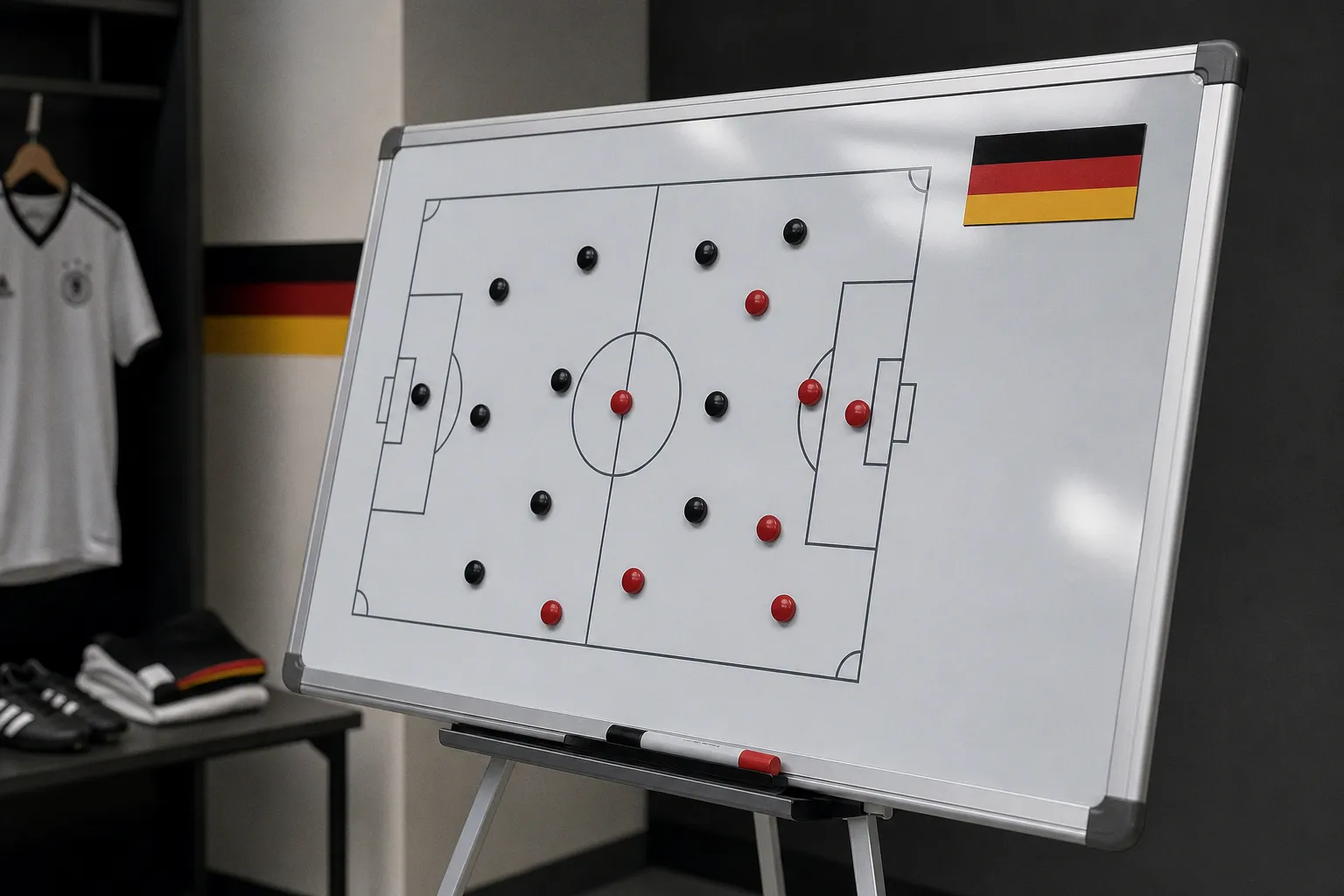
The Tactical Blueprint Behind Spain’s Impenetrable 2026 World Cup Defence
Spain's defensive record through the 2026 World Cup group stages and early knockout rounds—the tournament's lowest xGA ratio—isn't a product of individual brilliance. It's a system revelation.

The 3-2 Rest-Defence Morph
Spain's defining structural innovation lies in how the backline reconfigures during attacking phases. When possession advances, the defensive shape instantly collapses into a deliberate 3-2 formation—a pre-calculated net designed to eliminate central passing lanes and funnel opponents into wider, contestable zones. The inverted fullbacks, tucked inside rather than holding traditional width, provide the spatial density needed to suffocate transitional outlets.
This is not passive containment. It's proactive channel restriction. By deliberately conceding deep flanks, Spain guarantees that any counter-attack loses velocity before the primary defenders engage. The centre-backs consequently commit to significantly fewer desperation tackles than their rivals—danger is neutralised structurally before it reaches the penalty area. That conservation of physical output in North American summer heat becomes a compounding advantage across 90-minute tournament matches and extra-time scenarios.
Machine Learning as the Defensive Coordinator
What separates this system from a well-drilled low block is the analytical layer underneath. The coaching staff has deployed machine learning models trained on thousands of hours of opponent heat maps, passing networks, and individual player tendencies. The output: highly specific, match-customised pressing triggers for every opponent.
This isn't abstract data science. It directly dictates defensive line height, the exact moment midfielders step to disrupt build-up, and which half-space the ball-side centre-back must protect. Spain's defenders aren't reacting—they're executing pre-loaded spatial instructions tuned to each opponent's offensive profile. The result is a system where structural discipline replaces individual recovery speed as the primary defensive mechanism.
The Broader Tactical Implication
Spain's blueprint represents a paradigm shift for tournament football. The 2022 Morocco run demonstrated that an African nation could reach the semi-finals through disciplined defensive organisation. Spain's 2026 model raises the ceiling further: the question is no longer whether teams can defend deep and survive, but whether they can engineer a high-pressing defensive structure powered by predictive analytics.
For federations developing tactical frameworks, the data is explicit. Modern rest-defence—how you protect your goal while attacking—is the decisive variable. England's approach to their semi-final against Argentina hinges on the same principle: matching Argentina's half-space numerical overloads through deliberate fullback inversion and implementing aggressive "jumping" triggers where the ball-side defender steps into midfield the moment possession turns over. The risk profile is inherent—if the jump fails, the remaining defenders are exposed—but the alternative is passive absorption against elite central progressions, which tournament data consistently punishes.
Spain's coaching staff understood this calculus before the tournament began. Every other quarter-finalist is now forced to catch up mid-competition.